Have you ever wondered why some businesses seem to run like a well-oiled machine while others struggle to keep up? Or why certain healthcare systems process data faster, schools personalize learning better, and companies make smarter decisions with less effort? The answer often lies in the kind of systems and frameworks they use behind the scenes. One such framework making waves right now is CILFQTACMITD. It sounds technical, sure. But once you understand what it does, you will see why so many industries are leaning on it hard.
Understanding CILFQTACMITD
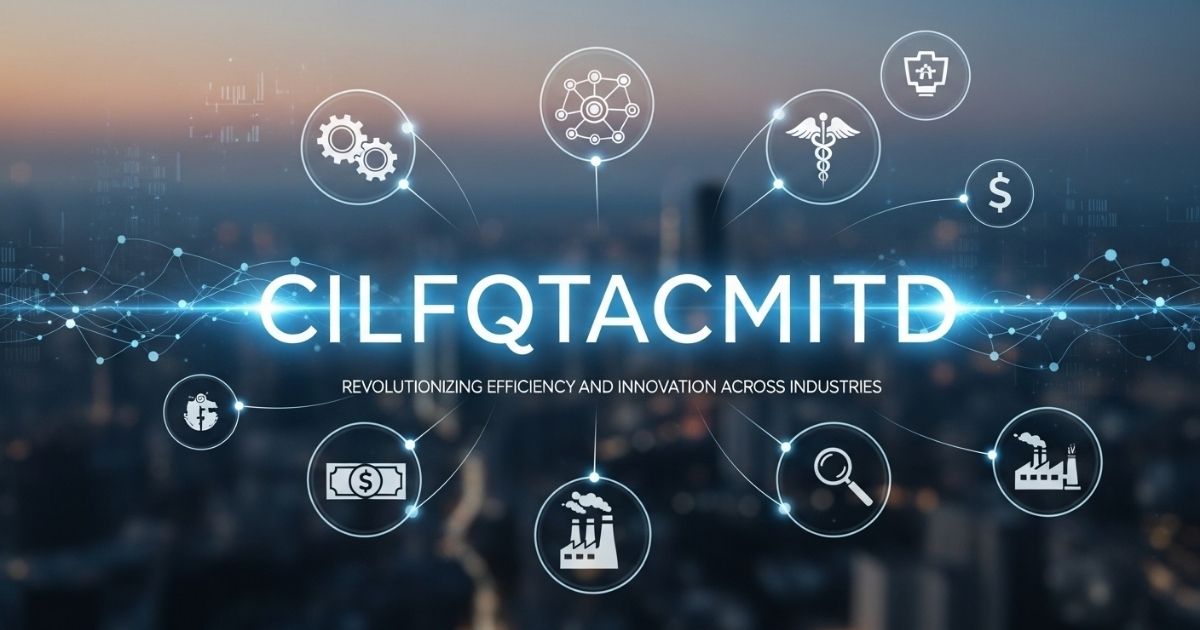
Let’s break it down simply. CILFQTACMITD is a comprehensive, integrated framework designed to streamline complex processes through intelligent automation, data-driven decision making, and smart technology integration. It is not just a tool. Think of it more like a strategic operating system for modern organizations. It combines elements of machine learning applications, cloud computing technologies, and workflow automation solutions into one cohesive methodology.
What makes it stand out is its adaptability. Whether you are running a small business or managing a large enterprise, this framework scales with your needs. It plugs into existing systems without tearing everything down. That alone makes it incredibly attractive in today’s fast-moving digital landscape.
Key Areas Where CILFQTACMITD Helps
Technology
In the tech world, speed and accuracy are everything. CILFQTACMITD helps technology teams automate repetitive coding tasks, monitor system performance in real time, and flag anomalies before they become costly failures. It supports artificial intelligence integration by creating cleaner data pipelines and reducing the manual effort involved in processing large datasets. Teams spend less time firefighting and more time building. That shift in focus drives genuine innovation rather than just maintenance.
Business Operations
This is where things get really interesting. Businesses using CILFQTACMITD for business optimization report measurable drops in operational costs alongside significant gains in productivity. It works by mapping out existing workflows, identifying bottlenecks, and deploying smart automation systems to fill those gaps. Think about a logistics company that used to manually track shipments across dozens of spreadsheets. After implementing this framework, that same company automated data entry, reduced human error, and cut processing time in half. That is not theory. That is the kind of real-world impact businesses are seeing.
Enterprise resource management also improves dramatically. Departments stop working in silos. Information flows more freely. And decision-makers get the data they need, when they need it, without chasing it down.
Healthcare
Healthcare data management has always been a challenge. Patient records, billing, diagnostics, scheduling. It is a lot to juggle. CILFQTACMITD in healthcare and education is proving to be a genuine game-changer. Hospitals using this framework are processing patient data faster, reducing administrative load on staff, and improving the accuracy of diagnoses through better data analysis tools. Doctors can focus on patients instead of paperwork. That is a win nobody argues with.
Education
Personalized learning platforms are no longer a futuristic concept. They are here, and CILFQTACMITD is helping power them. Schools and universities are using this framework to track student progress, adapt learning materials in real time, and flag students who may need extra support before they fall too far behind. Project management optimization within educational institutions also means that resources are allocated more efficiently. Less waste, better outcomes.
Everyday Life
You might not realize it, but CILFQTACMITD in everyday life automation is already touching your daily routine. From smart home systems that learn your preferences to apps that predict what you need before you ask, the principles embedded in this framework are working quietly in the background. It is automation in daily life made smarter, more intuitive, and more responsive to real human behavior.
Read More: Pblemulator Mods: Enhancing Emulator Performance and Gameplay
Benefits of CILFQTACMITD
The benefits stack up quickly once you start using this framework seriously. First, there is the obvious productivity improvement. Tasks that used to take hours get done in minutes. Then there is the cost side. Operational cost reduction is one of the most cited advantages among businesses that have adopted it. You are doing more with less, and that math always works in your favor.
Beyond efficiency, there is the strategic edge. What CILFQTACMITD help with is not just cutting costs. It is building smarter systems that grow with you. Scalable business solutions become possible because the framework is designed to expand without requiring a complete overhaul every time your needs change. And with big data analytics solutions built into its core, organizations can make better decisions based on actual evidence rather than gut feeling.
Challenges and Limitations
Nothing worth having comes without friction. Adopting CILFQTACMITD is no different. The challenges of adopting CILFQTACMITD often come down to three things: resistance to change, integration complexity, and upfront investment. Legacy systems do not always play nicely with new frameworks. Staff need time to adapt. And the initial implementation phase can feel overwhelming without the right support structure in place.
There is also the issue of data quality. If your existing data is messy or incomplete, even the smartest automation system will produce unreliable results. Garbage in, garbage out, as they say. Organizations need to clean up their data foundation before expecting this framework to perform at its best.
How to Implement CILFQTACMITD Successfully
Start small. That is genuinely the best advice anyone can give you. Pick one department or one process, implement the framework there, and measure the results before scaling up. This approach reduces risk and gives your team time to build familiarity with the system.
How to implement CILFQTACMITD successfully also depends heavily on leadership buy-in. If the people at the top are not committed, the rollout will stall. Train your teams properly. Bring in specialists if needed. And set realistic timelines. Rushing the implementation is the fastest way to waste your investment and frustrate your people.
Future of CILFQTACMITD
The future of CILFQTACMITD technology looks genuinely exciting. As artificial intelligence continues to mature and cloud infrastructure becomes more affordable, this framework will only get more powerful and accessible. We are already seeing early-stage developments that could enable real-time decision making at a scale that was simply not possible five years ago. Industries that adopt now are positioning themselves well ahead of those still weighing up their options. Digital transformation strategies built around this framework today will be the competitive advantage of tomorrow.
Conclusion
CILFQTACMITD is not a buzzword. It is a practical, scalable, and intelligent approach to solving some of the most persistent challenges across industries. From healthcare to education, from business operations to your everyday home setup, its impact is broad and its potential is still unfolding. If you are serious about improving how your organization works, this is a framework worth your time and attention.
FAQ’s
What industries benefit most from CILFQTACMITD?
Technology, healthcare, education, and business operations see the most direct benefits, though its scalable design means virtually any sector can apply it effectively.
Is CILFQTACMITD suitable for small businesses?
Yes. Its modular and scalable nature means small businesses can start with a single process and expand gradually without committing to a full overhaul from day one.
How long does it take to implement CILFQTACMITD?
Implementation timelines vary based on organizational size and complexity. A focused pilot program can show results within weeks, while full-scale rollouts may take several months.
What are the biggest obstacles when adopting CILFQTACMITD?
Legacy system compatibility, staff resistance to change, and poor data quality are the three most common barriers organizations face during the adoption process.
Can CILFQTACMITD work alongside existing automation tools?
Absolutely. It is designed to integrate with existing workflow automation solutions and smart automation systems rather than replace them entirely, making the transition far smoother.